5. The Dissemination principle: Supporting external communication of One Health Surveillance outcomes
Purpose
The dissemination principle defines that better surveillance data integration and interpretation needs improved cross-sector One Health Surveillance report integration and harmonization. The resources provided within this principle are meant to support the cross-sector harmonized provisioning of metadata in OHS reports and e.g. to provide a foundation for advice to risk managers. Best practice examples illustrate how the reporting of surveillance outputs using new checklists and templates relying on cross-sectoral analysis of surveillance outputs, will improve the value for all stakeholders. It also demonstrates that such activities support the cross-sector understanding of contextual information in future OH surveillance reports.
Scope
The resources provided within this principle are directed towards the activities linked to report generation or dissemination of surveillance data and results. Proposed solutions were designed to be generically applicable for any surveillance activity in all OH sectors, including those that were not directly involved in their development e.g. the environmental sector. In addition they should be applicable to all European countries, geographic areas and administrative levels.
Methods
One Health Consensus Report Annotation Checklist (OH-CRAC)
To achieve OHS report harmonization we are proposing the establishment and adoption of a so-called “One Health Consensus Report Annotation Checklist” (OH-CRAC). The adoption of OH-CRAC will allow all existing OHS metadata to be mapped to one concurrent metadata schema, instead of cross-mapping metadata between several sectoral and institutional metadata systems as illustrated in Figure 5. The implementation and comprehension of the OH-CRAC will thereby cause minimal efforts for all involved parties. OH-CRAC is also available as an interactive online tool that allows the provisioning of surveillance meta-information in an easy and user-friendly manner
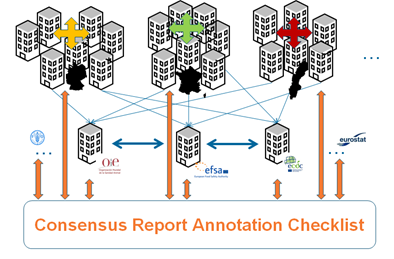
Fig. 5: Schematic drawing of OH-CRAC that is proposed to map and structure metadata in One Health surveillance reports. Orange arrows indicate the mapping of metadata from federal/national systems (top) and European/international stakeholders (bottom) systems to the proposed OH-CRAC.
National OHS Report Templates
Surveillance of zoonoses and antimicrobial resistance (AMR) is often carried out in multiple animal species, foods and/or people and reported separately. Sometimes, outputs from different sectors are reported in the same report or in the same chapters, but usually every author/sector provides their own text and graphics. This tends to present the providers’ perspective rather than focussing on the receiver needs and may not interpret the data from a One Health perspective. To support One Health reporting, examples or templates to report different types of hazards with a One Health focus have been developed. The templates demonstrate how to report e.g. AMR in foodborne zoonoses throughout the food chain and focusing on the consequences for humans and animals or how to report zoonotic trends, whilst enhancing the One Health focus.
Guidance on reporting antimicrobial resistance in a One Health perspective: https://drive.google.com/file/d/1qvWe5_dnNGoipMbHbbjBHqT0fLvQ01ar/view?usp=sharing
Training materials and examples for OHS reports
Outbreaks of infectious diseases in Norway in 2020. Annual report (Utbrudd av smittsomme sykdommer i Norge i 2020. Årsrapport)
This report provides an overview of outbreaks that have been notified to the Norwegian Institute of Public Health in 2020. It is important to point out that this overview does not provide a full and complete picture of outbreaks in Norway during this period. The degree of underreporting varies considerably. This report is based on information from the outbreak alert system, Vesus (www.vesuv.no)which contains information on outbreaks of infectious disease in the population and the cause of the outbreaks.
Link: https://www.fhi.no/publ/2021/utbrudd-av-smittsomme-sykdommer-i-norge-i-2020/
Norwegian Annual report 2020 - Surveillance of infections from food, water and animals including vector borne diseases
This annual report describes the incidence of the most common diseases that are transmitted by food, water and animals, including vector-borne infections, which have been reported to the Norwegian Institute of Public Health in 2020. The report includes interactive links to websites with further background information on the various diseases mentioned in the report.
Link: https://www.fhi.no/publ/2021/arsrapport-2020-smitte-fra-mat-vann-og-dyr/
Surveillance of infectious diseases in animals and humans in Sweden 2020
Surveillance of infectious diseases in animals and humans is the annual report describing the surveillance activities carried out in Sweden during the year. The report covers surveillance for important animal diseases and zoonotic agents in humans, food, feed and animals, carried out and compiled by experts from several Swedish governmental agencies, university and the private industry with surveillance mandates along the entire food chain, from farm to fork.
Examples & Lessons learned
The pilot studies carried out in the ORION project confirmed that the impact of surveillance activities largely depends on the effectiveness of the dissemination process. In the execution of the pilot studies in the ORION project it was highlighted the importance of involving relevant actors participating in the surveillance activity during the writing of the dissemination outputs. This means not only participants from within each organisation but also from all other agencies, collaborators and stakeholders involved to ensure that the output is correctly contextualised. Another practical aspect that complicates surveillance result dissemination is the fact that despite agreements for data sharing across different bodies/institutions might exist the different internal policies can make the dissemination of data complicated and slow.
The Belgian and Danish pilots conducted during the One Health EJP H2020 ORION project considered as important the dissemination of results, not only at national level but also to other countries (pilot reports provided as annexes under the deliverables JIP1-2.7 and JIP1-2.9, respectively) [21], [22]. In general, it was highlighted that the dissemination of surveillance outputs should be more frequent transparent and concise in the future. In the German [23], Swedish [24] and Danish [22] pilots it could be shown, that in order to create OH oriented surveillance reports it might be useful to change the structure of current surveillance reports, e.g. by introducing new sections, re-structuring them into OH chapters to harmonise the provisioning of the outputs or by using checklists like OH-CRAC. From the experience within the ORION pilots one can conclude that the efforts needed to implement such improvements are well invested, as the newly designed surveillance reports were very well accepted by policy users. Also the application of the new OH-CRAC checklist was tested extensively and received positive feedback.
References
| [21] | Gethmann J, Selhorst T, Dups-Bergmann J, Ellis-Iversen J, Friesema I, Lagesen K, Dórea F, Kuhn K, Dispas M, Gonzales Rojas J, Jore S, Jernberg C, Cook C, & Larkin L. (2021). Deliverable JIP1-2.7 Revised OH Knowledge Base - Epi, including lessons learned from the OH pilots. Zenodo. https://doi.org/10.5281/zenodo.5062653 |
| [22] | (1, 2) Ellis-Iversen J, & Foddai A. (2021). Deliverable JIP1-2.9 Revised OH Knowledge Base - Integration, including lessons learned from the OH pilots. Zenodo. https://doi.org/10.5281/zenodo.5062452 |
| [23] | López de Abechuco E, Filter M, Buschhardt T, Scaccia N, Günther T, & Dórea F. (2021). Deliverable JIP1-1.3 Revised OH Surveillance Codex, including lessons learned from the OH pilots. Zenodo. https://doi.org/10.5281/zenodo.5062641 |
| [24] | Dórea F, Günther T, López de Abechuco E, Holmberg M, Jernberg C, Hjertkvist M, Filter M, Foddai A, Ellis-Iversen, J, Cook C, Lawes J, Larkin L, Friesema, I, Filippitz, M.E.;, Cargnel, M, Boseret, G, & Lagesen K. (2021). Deliverable JIP1-3.3 Revised OH Harmonisation Infrastructure Hub, including lessons learned from the OH pilots. Zenodo. https://doi.org/10.5281/zenodo.5062410 |